


We help organizations move from fragmented data assets to autonomous, federated data products—without replatforming or scaling central teams.
Built and delivered by the team that invented data mesh and autonomous data products.

Each new data project requires bespoke pipelines across orchestration, governance, and observability tools.

Governance, quality, and security reviews add 30-40% process overhead to every project.

Manual controls and brittle pipelines make AI experimentation slow, risky, and expensive.

Throwing people at the current data operating model
Re-deploying generic playbooks
"Science project" proofs of concept

Install an operating model that scales into the future
Train and transfer product ownership to domains
Leave behind working patterns, not dependencies

Clear patterns for building, governing, and evolving data products across domains.

Teams that own their data products end-to-end, without ongoing central dependence.

Working workflows, standards, and lifecycle controls that remain after the engagement ends.
Each phase is bounded, de-risked, and designed to deliver measurable outcomes.

Validate tooling + operating-model fit
Thin-slice architecture, UX, and org alignment
Clear decision gate
Confidence to proceed, or understanding why not
Quickly adapt existing assets into governed data products
Establish discoverability and consumption patterns
Create reference products andworkflows
Proof of repeatability, not just one-time success
Move from proving patterns to running them at scale
Establish reusable libraries, contracts, and operating patterns
Integrate Nextdata OS into existing workflows
Reduce central dependency
Business domains can build and operate data products independently
Transition ownership to domain teams
Scale governance, quality, and lifecycle controls
Measure adoption and velocity
Federated data product organization
Measured by adoption, velocity, and reduced central dependency.




.png)
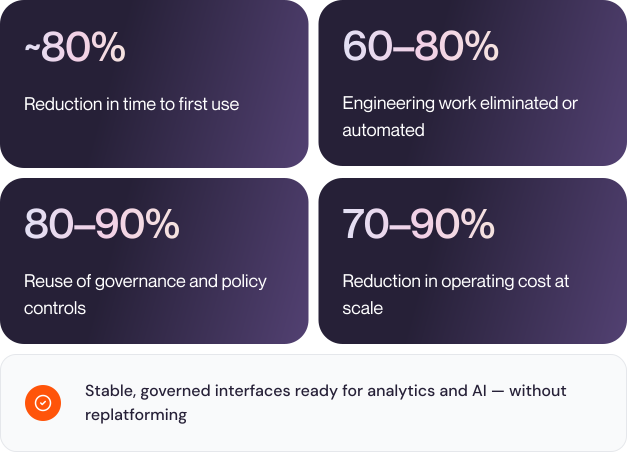
A global, multi-business enterprise faced these same challenges. Despite years of investment in platforms, tools, and external support, delivering a single data product routinely took 6–12 months and cost $1M+. Governance was fragmented, quality controls were manual, and trust in curated data was low—making AI adoption slow, risky, and expensive.
Rather than adding new tools or centralizing platforms, the organization changed its data operating model. Existing assets were repackaged into autonomous, domain-owned data products, with governance, quality, and security embedded as reusable standards from the start.

Data mesh creators with deep operational expertise across regulated, global, high-scale environments, not just tooling

Founder and CEO
Creator of data mesh architecture, former principal consultant at Thoughtworks, author of 'Data Mesh: Delivering Data-Driven Value at Scale'

Head of Product Engineering
Former engineering leader at major tech companies, expert in distributed systems and data infrastructure architecture

Head of Engineering
Former Mesosphere/D2iQ, specialist in cloud-native infrastructure and platform engineering at scale
.png)
We bias toward capability transfer, not delivery volume
We front-load learning to reduce downstream cost
We design for exit, not dependency
We scale through patterns, not headcount


