AI-ready data products
AI-Native Pharma: From Context to Action
[A recap of the October 21st Nextdata webinar with Zhamak Dehghani and Sina Jahan, the third session in our AI-Native series.]
Thank you to everyone who joined AI-Native Pharma: From Context to Action.
Our first two AI-Native sessions laid out how to redesign work around outcomes and how to give agents a semantic interface to enterprise data. This one carried both ideas into pharma. Zhamak was joined by Sina Jahan, who leads Nextdata's forward-deployed engineering team and spends his days inside pharma companies, building the first working version of things their own teams later scale.
Pharma is where AI-native work gets tested
Pharma runs on knowledge, documents, and data. Nearly every function, from discovery to the field, depends on people finding information, interpreting it, and deciding with it. That is work LLMs do well, and the decisions involved (which molecule to advance, how to design a trial, which patients to enroll) shape how quickly a drug reaches the people who need it.
A McKinsey analysis Zhamak cited broke life sciences into 270 workflows, more than 1,200 tasks, and about 180 job families. It estimated that agents could take on some part of 75 to 85 percent of those workflows. In clinical development the gains compound: trials finish sooner, and the same team can run more of them.
The report also lists the conditions for capturing that value: shared data semantics, clear data ownership, and workflows redesigned from the outcome back. Those are hard to meet anywhere. Pharma makes them harder in four ways.
- The work is diverse. A computational scientist designing a trial and a rep planning a physician visit need different data, different agents, and often different models.
- Every answer must be auditable. Regulators expect a trail from each agent action back to the data it touched and the permissions it held.
- The stack is heterogeneous. Multiple CRMs, Snowflake and Databricks side by side, plus clinical, lab, and contract systems.
- The best use cases cross functional lines. R&D, clinical, and commercial each have good reason to control their own data, and the most valuable questions draw on all three.
In Sina's experience, model access was the question of 2024 and 2025. His customers have since moved on to the harder problem of getting organizational context into their agents, and none of them has fully solved it yet.
Context is the bottleneck
When agents attempt pharma jobs such as drafting a study report or triaging a safety case, they tend to fail in a few predictable ways. They can't find the right information, can't tell which copy to believe, can't resolve what an ambiguous term means, or aren't permitted to use what they found.
Nextdata's answer is the autonomous data product. Each one is owned by the domain that knows the data best and bundles what usually lives in separate systems: the pipelines that produce the data, its semantic model and glossary, its links to related business concepts, its quality rules, and its access policies. It sits on top of existing platforms, so nothing has to migrate. Because data, meaning, and access live together, the meaning stays attached to the data wherever an agent finds it.
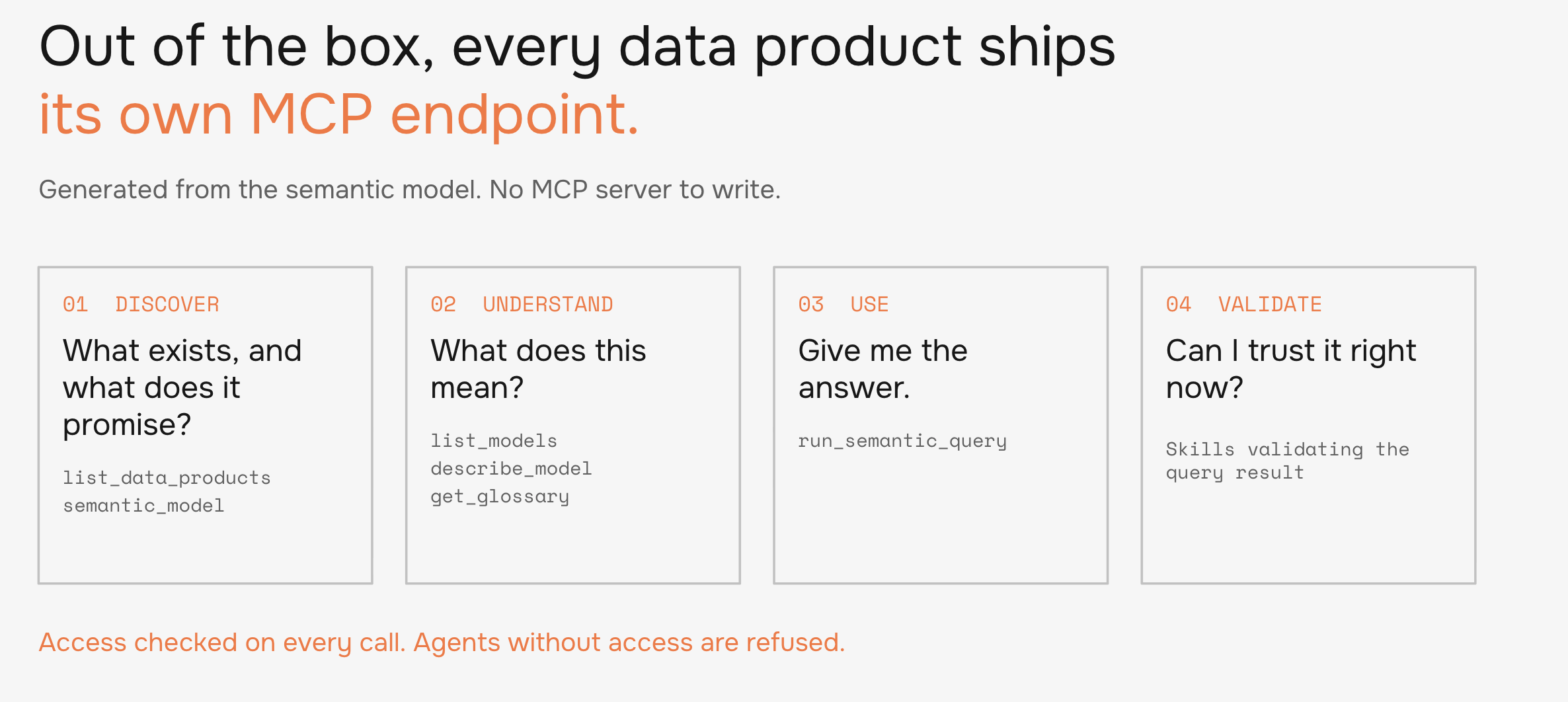
Agents reach these products over MCP, extended with four verbs every product supports: discover, understand, use, and validate. Together the products form the narrow waist of an hourglass, with any agent or model above it and any storage or compute below.
Rules belong in software
Asked which of pharma's challenges bites hardest, Sina picked compliance and data sharing. Syndicated data arrives under contracts that specify who may use it and for which purposes. Internal data carries similar restrictions. Today those rules mostly live in documents that people read, and that agents are now expected to read as well. That arrangement doesn't survive contact with agents working at machine speed.
The rules have to be encoded as running software, so an organization can show that each agent sees the correct data and nothing beyond it, and that every action is logged against its GxP framework. Zhamak called this computational governance, a capability the industry discussed for years with little to show for it. On Nextdata, every data product and MCP endpoint runs its policies as code, authenticating and authorizing each agent along with the person it acts for.
Heterogeneity is the starting condition
The worked example came from a Nextdata customer and began with the most strategic question a company asks: where to invest. One input is a recurring read of the market, which agents condense into a package the strategy team reviews before people make the call. At its center sits a single question: where is our brand losing share to competitors in its lead indications?
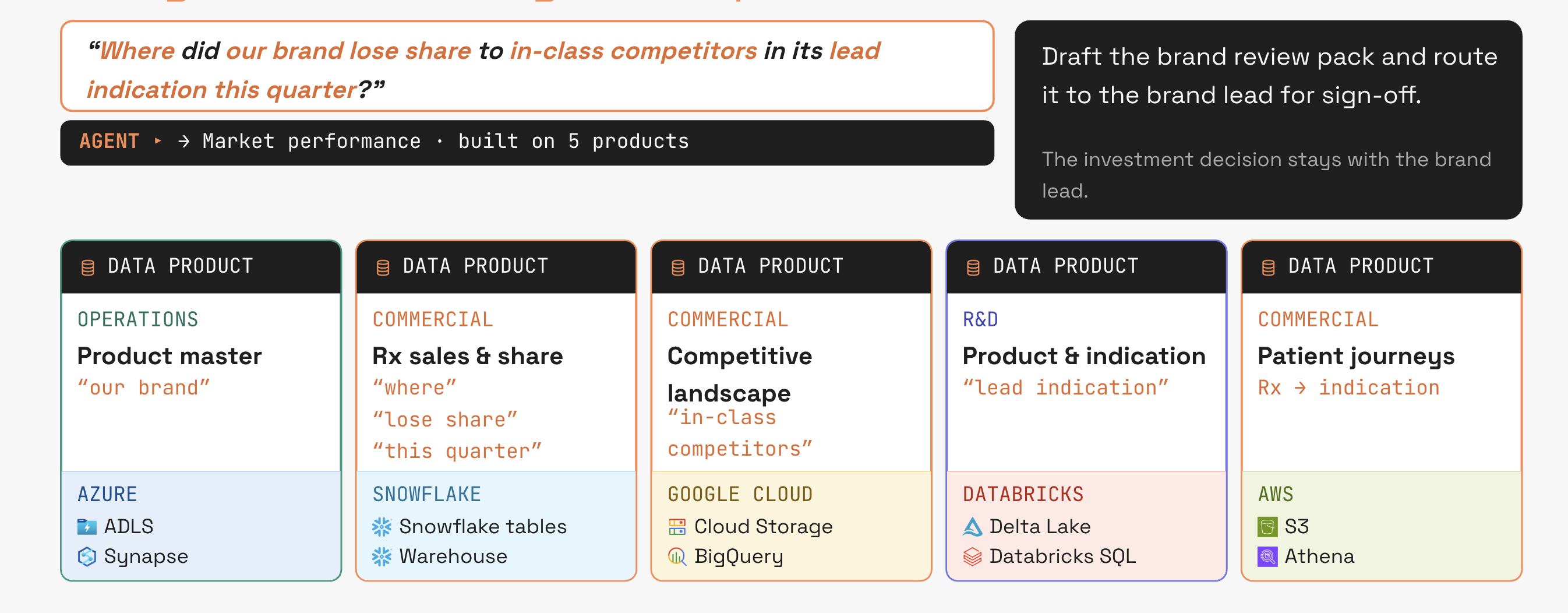
Answering it drew on research, operations, and commercial data spread across four stacks. Product master lived on ADLS and Synapse, sales on Snowflake, part of the business on BigQuery, and part on Databricks and AWS. In pharma that spread is normal, and any approach that requires consolidating it first won't get far.
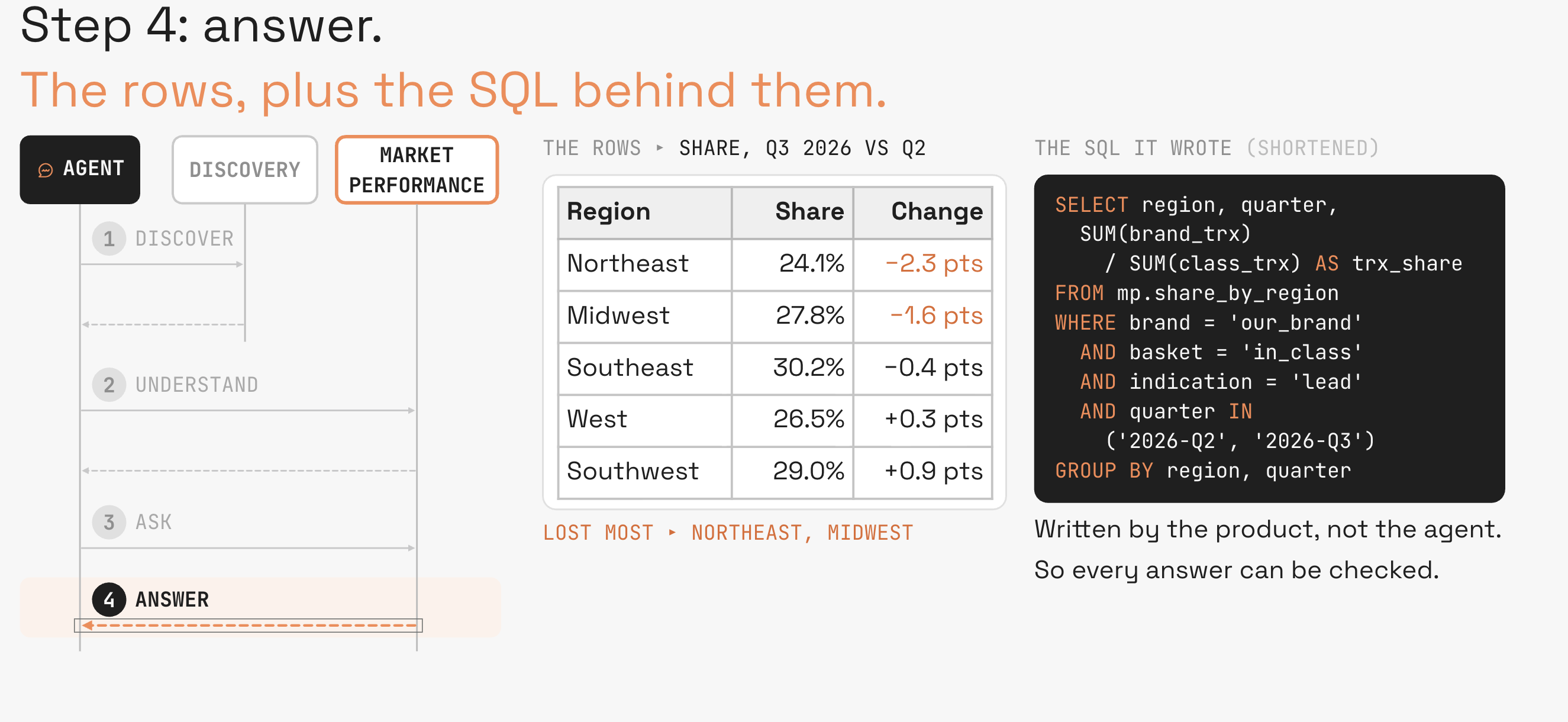
The agent worked through it in four moves.
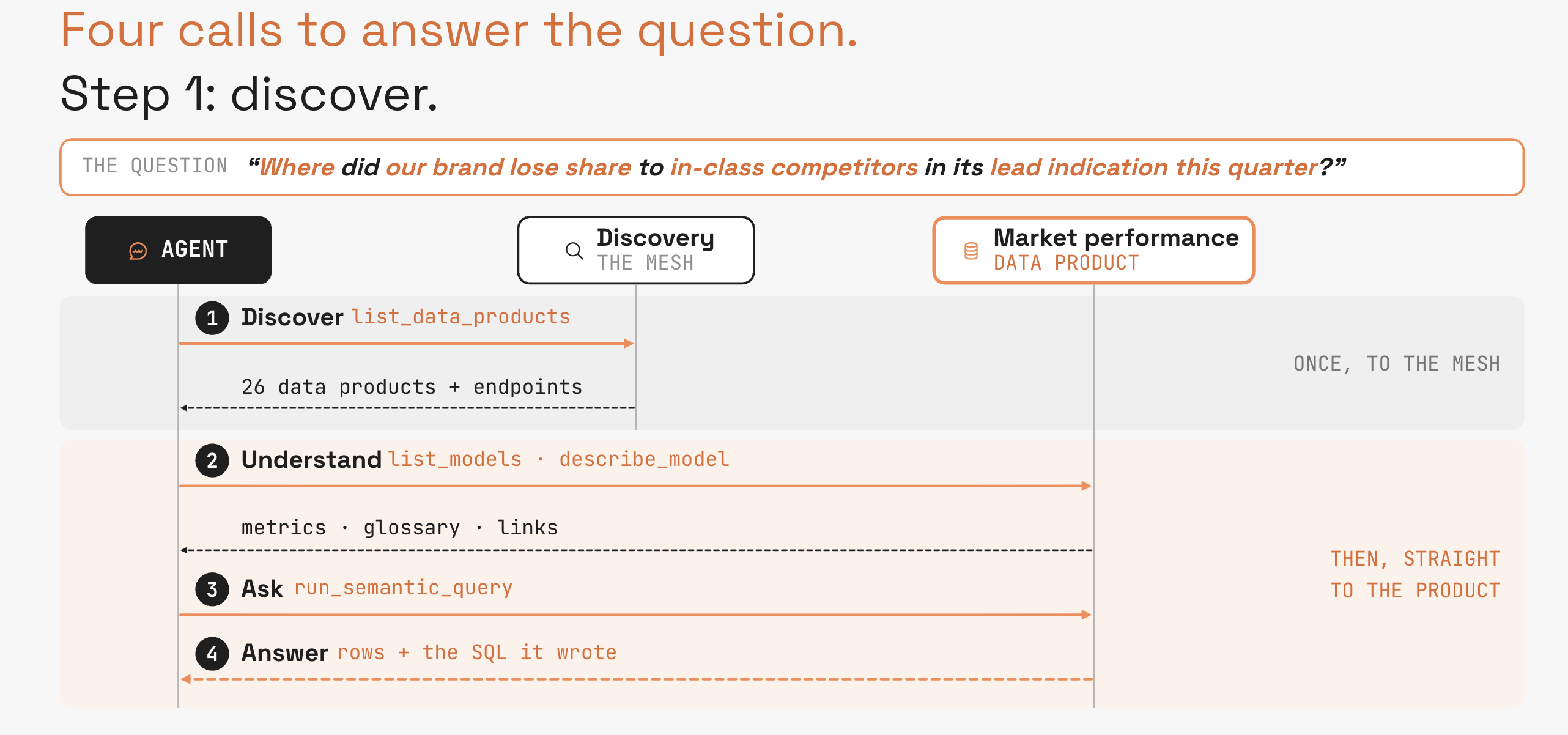
Step 1: It asked Nextdata's system data products, which catalog the whole mesh, what existed for "brand," "competitor," and "lead indication," and was pointed to four products.
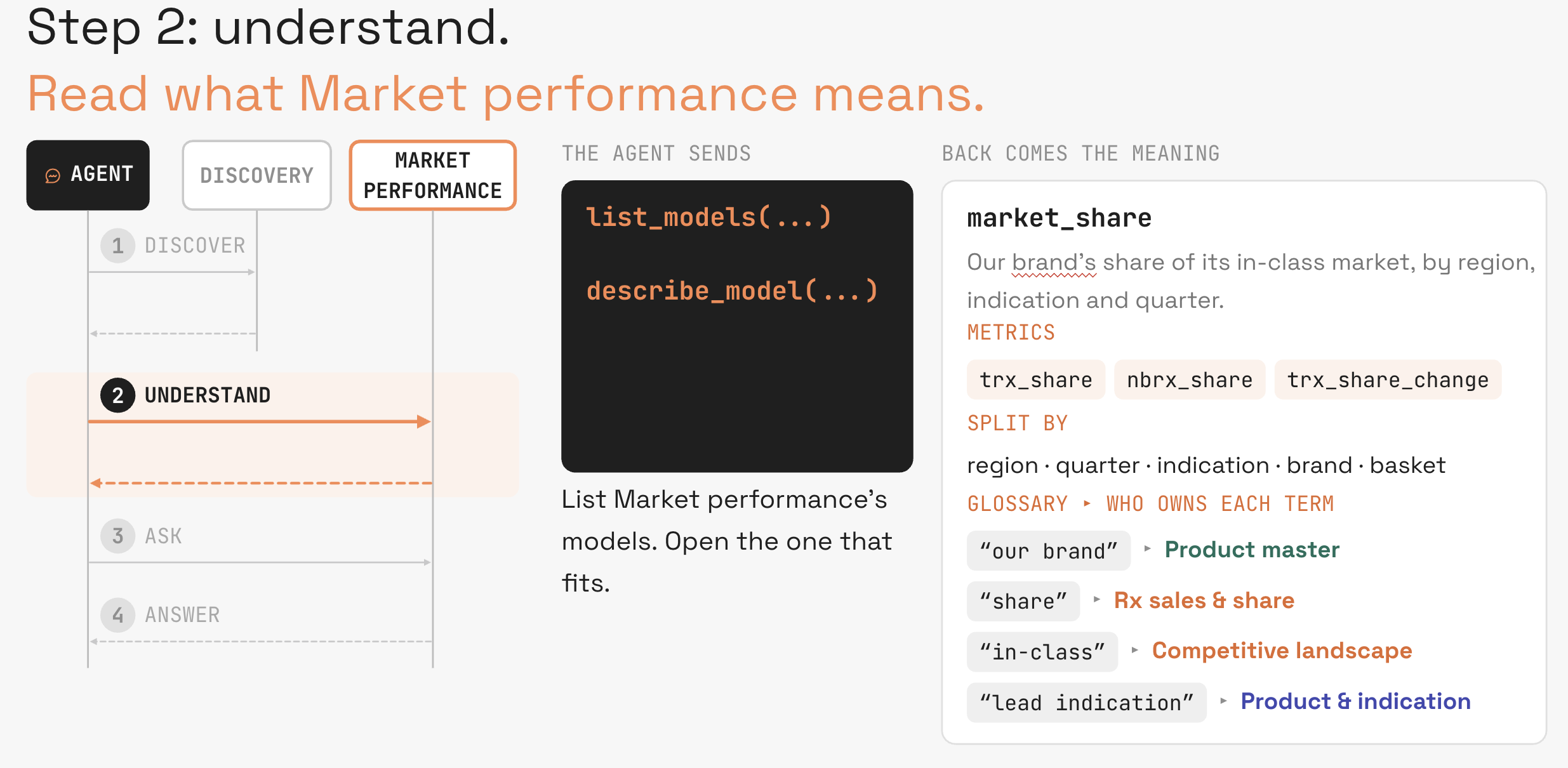
Step 2: It asked the market share data product which metrics, dimensions, and terms it publishes to, to understand its semantic meaning.
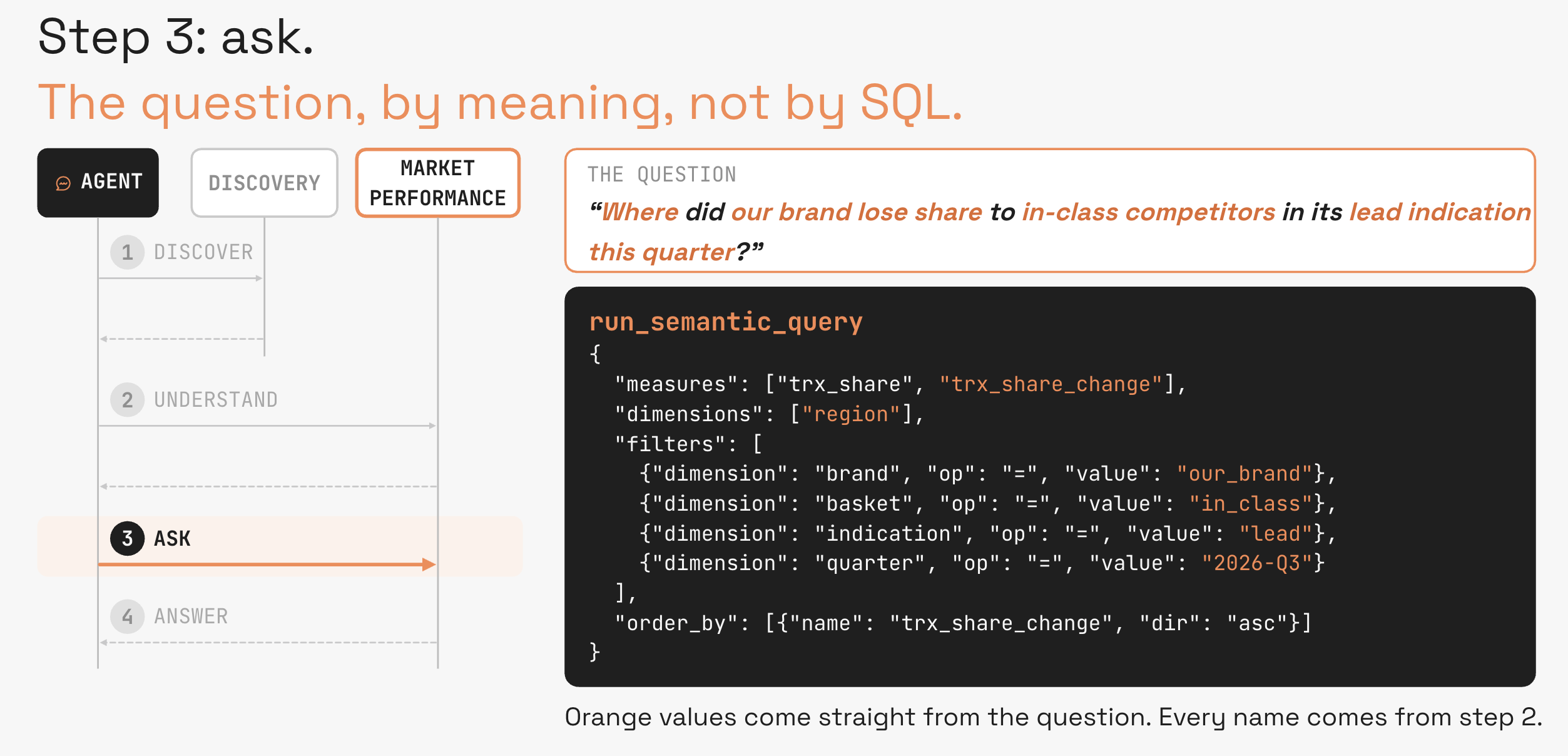
Step 3: Then it sent a semantic query, which the data product translated into SQL (Step 4:) for the underlying platform, and then got share by region back, and the SQL itself was recorded by Nextdata OS as part of the data product's logs to allow for verification.
Trust you can measure
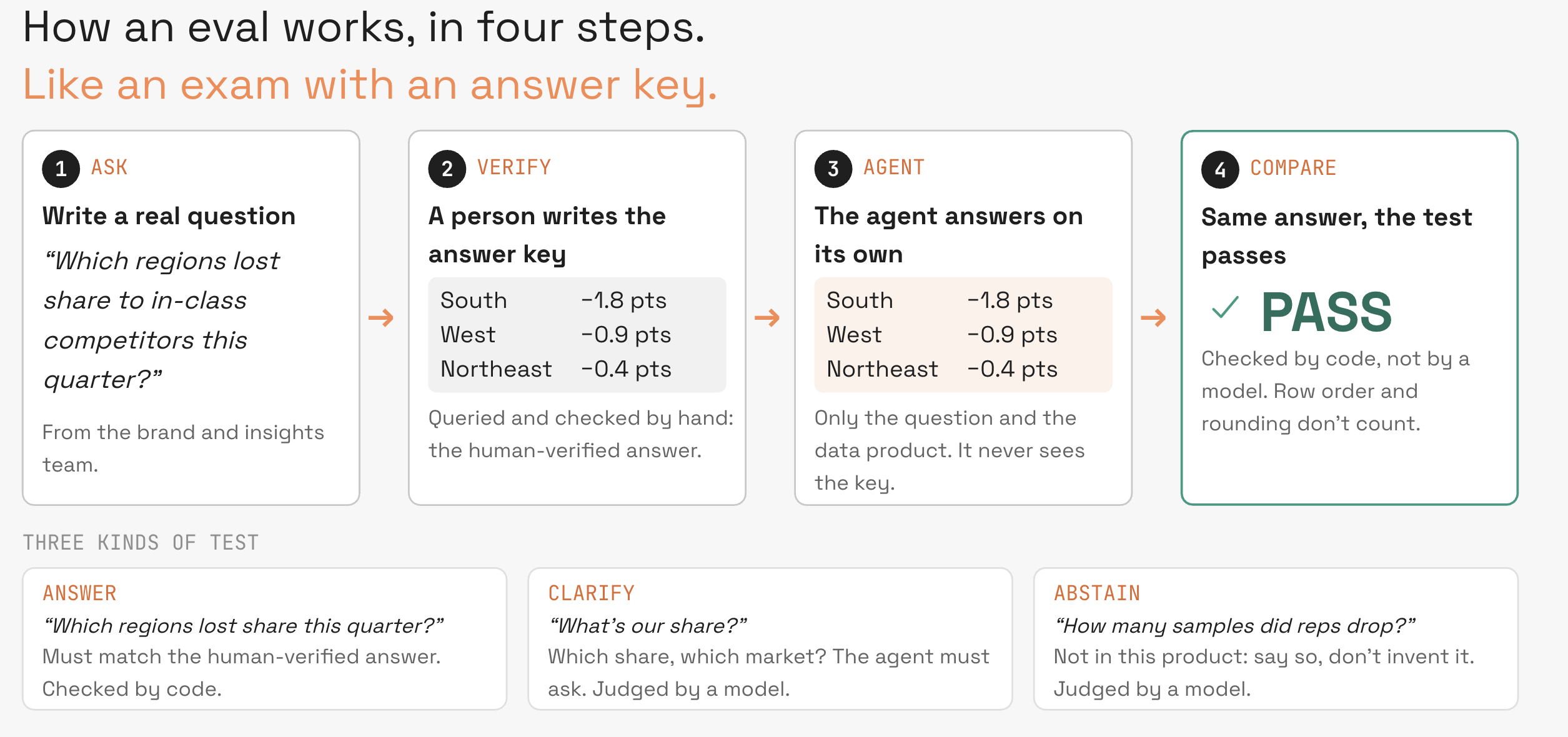
An agent that returns plausible numbers that don't match the business's own numbers loses trust quickly and rarely wins it back. Nextdata uses evals as the shared language between engineers, data product owners, and the business. Domain experts write questions with known, human-verified answers: our current share, which regions lost share, how share moved month by month. Some tests expect the agent to ask for clarification or decline, since an honest refusal costs less than a wrong figure.
The team then improved the data products in layers and measured each one against the same suite.
The first layer was a coin toss. Metric annotations let the agent ask precise questions. The remaining gap came from duplication, with similar concepts owned by different teams and no clear source of truth. Glossaries, which in Nextdata are themselves data products owned by cross-domain teams, closed it.
Whether 95 percent is enough is a call for the data product owners and the people deciding with the results. The team is now building evals into the CI/CD lifecycle of every data product, which retires the old argument that it worked in Perplexity yesterday and broke in Claude today.
AI builds the data products, people own them
At Nextdata, data products in production are now generated by AI and curated by people. Sina recommends that teams build their first few by hand anyway, because good curation depends on knowing what sits underneath. Nexty, Nextdata's set of agentic tools, can generate products from existing data or source code, with generation from intent arriving soon. A copilot drafts semantic definitions from the data model, a person reviews them, and the evals show whether they helped.
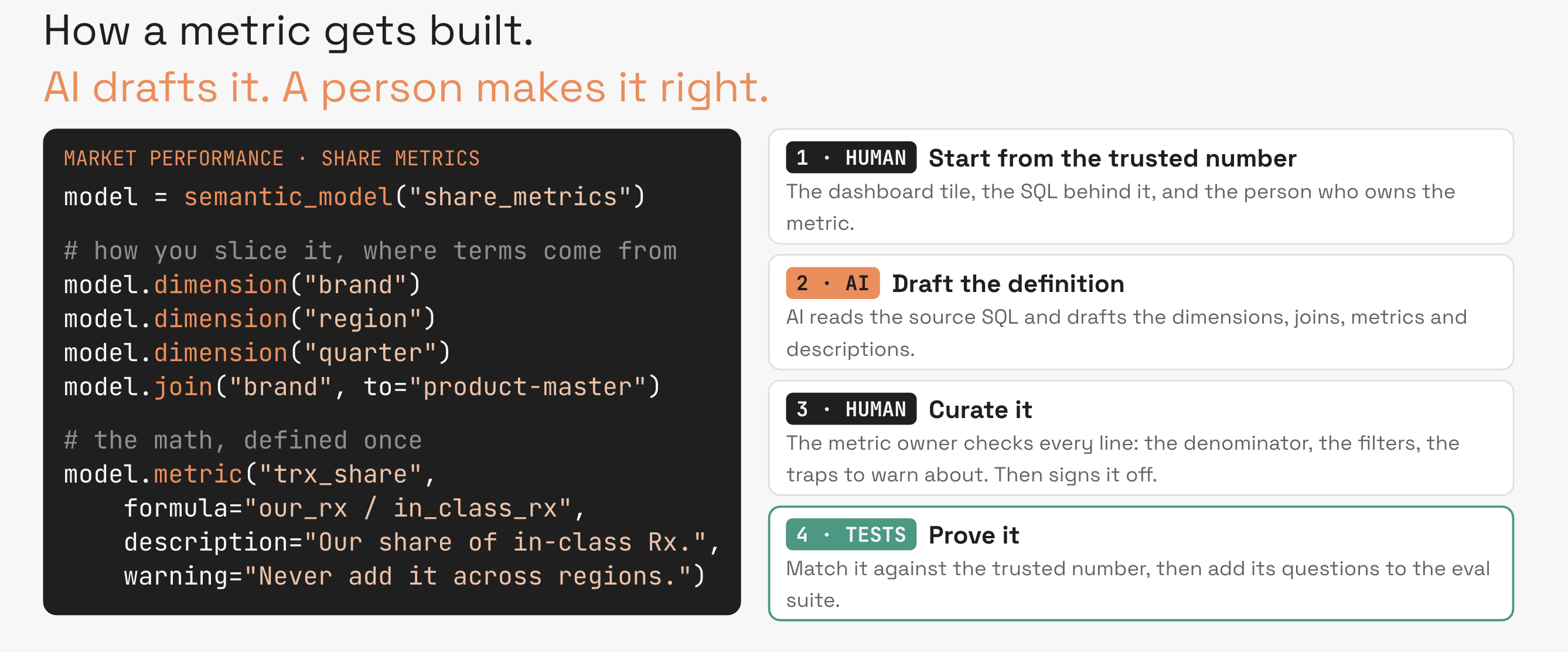
Ownership is also how context stays current. A product's data, definitions, contracts, quality rules, and policies are managed together as code, so a change in the business becomes a change in one place. The product's kernel checks that data matches its semantic definitions both as it is written and as agents read it.
That design also separates Nextdata from warehouse semantic layers, which work well when all the data sits in one warehouse. Nextdata distributes semantics across products, each an API with its own URL, and can still export the whole mesh as RDF or Open Semantic Interchange definitions for tools that expect them.
Adoption in weeks
Nextdata takes organizations from ambition to production in four phases, each adjusting the platform, the people, and the operating model.
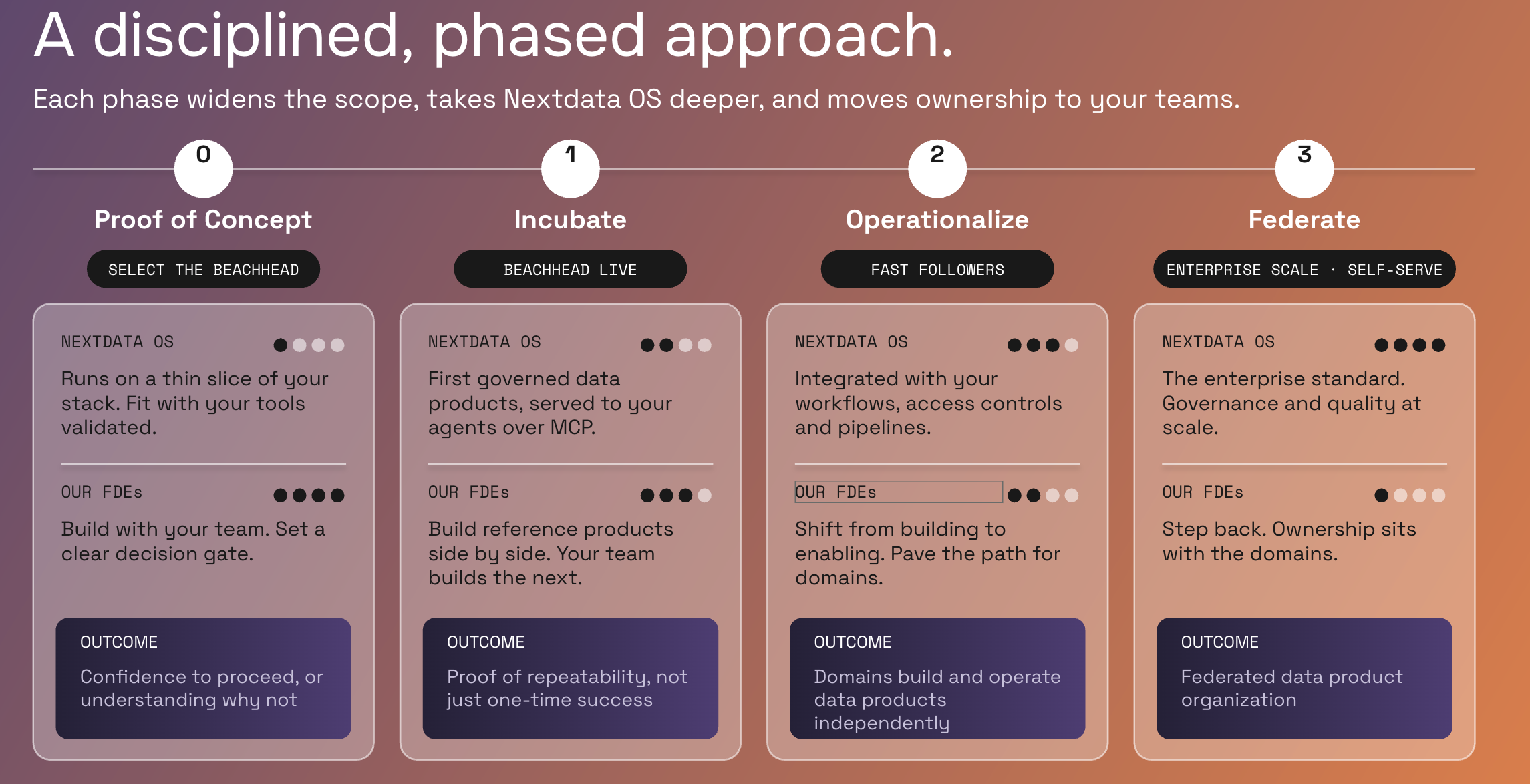
- Beachhead (2 to 4 weeks). Pick a first domain and outcome where data already exists, and prove the approach on a thin slice of your own stack.
- Incubation (about 3 months). One to five use cases go live in production, built on the first governed data products. Forward-deployed engineers build the reference implementations alongside your team.
- Operationalization. More domains join in parallel. The platform connects to audit, security, and workflow systems such as ServiceNow, and the FDEs shift from building to teaching.
- Self-serve and federation. Domains build their own data products and agentic solutions under codified governance, and the FDEs step out.
Sina's advice is to win trust quickly before launching a broad change-management program, since planning cycles of six to nine months no longer fit the pace. His favorite phase is the last one, when a customer's own engineers start teaching the FDEs. Zhamak recalled one customer arriving at a call eager to show off the playbook his team had written for building and validating agent-ready data products.
Up next: a customer tells their story
The AI-Native series continues every other Wednesday at 9 AM PT through the end of the year. On November 4th, Omar Khawaja will share the story of how his team put an AI-ready context layer to work across argenx and more product launches are on the way. Register to join live or to get the recording.
If you'd like to talk about bringing governed, agent-ready context to your pharma or life sciences organization, book a meeting with us.
More resources
- Missed session one? Read the recap: Agents, Automation, and Humans: Drawing the New Lines of Enterprise Work
- Announcing the semantic mesh: activating enterprise context beyond MCP connectivity
- Whitepaper: Building Data Agents Outside the Lakehouse Monolith
See how Nextdata works with pharma and life sciences teams, or request a sandbox at sales@nextdata.com