Data for AI
Autonomous Data Products
AI-Native
AI-Native: Ask Us Anything — autonomous data products, live
AI-Native series · By: Zhamak Dehghani and Bill Graham
Thank you to everyone who joined us live on November 18 for AI-Native: Ask Us Anything. If you missed it, you can watch the full recording here (link to come).
Every week, data and AI leaders ask us the same big questions. How do autonomous data products actually work? How do they give agents trusted context without another round of pipelines? And how do they fit alongside the lakehouse, catalog and governance tools you already have?
So we stopped answering in slides and showed it.
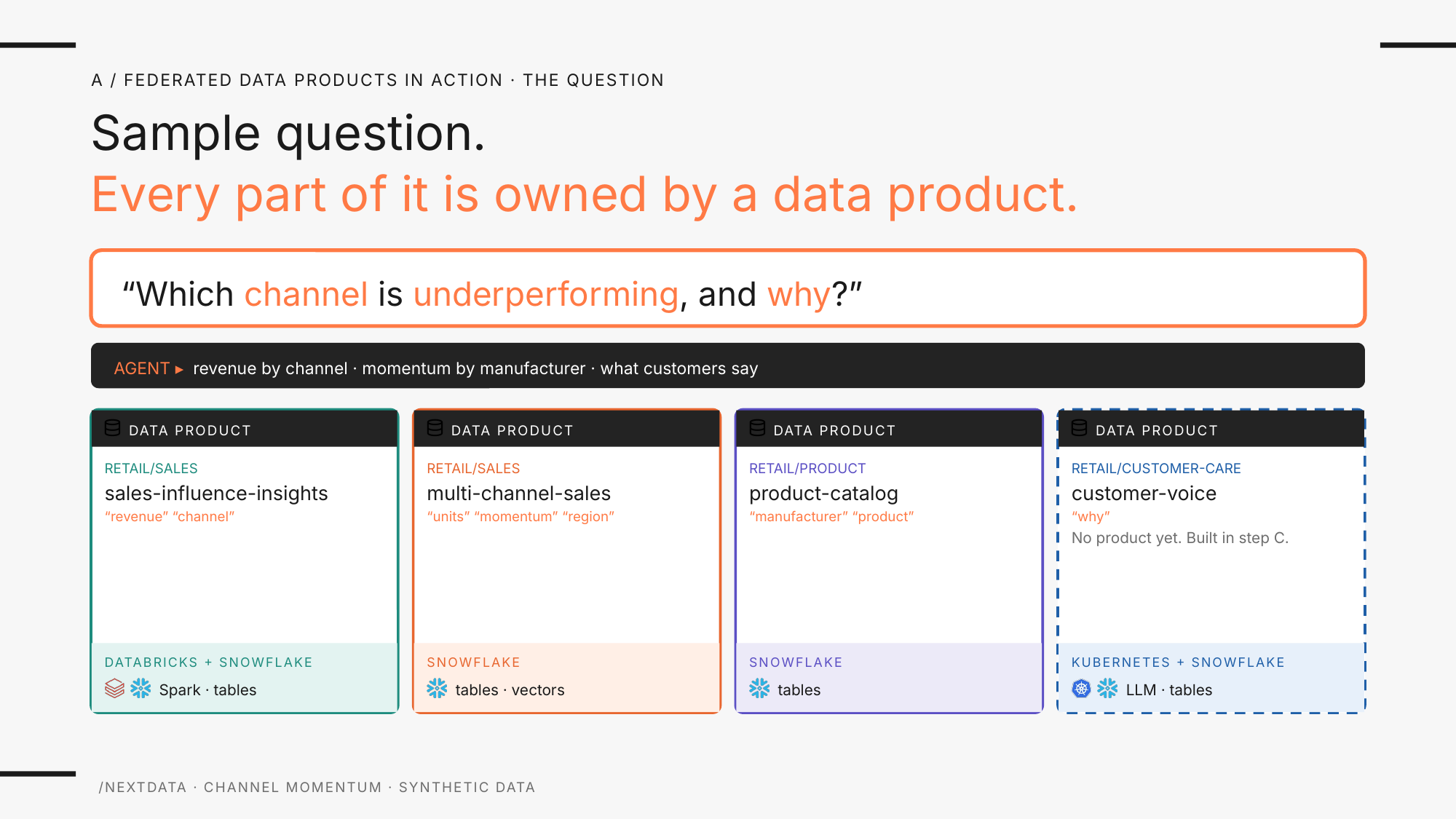
We built the session around one business question, the kind that cuts across every team in a company: “Which channel is underperforming, and why?” Answering it takes revenue data owned by sales, momentum data owned by a different sales team, product data owned by the catalog team, and something nobody had published yet: what customers are actually saying.
We ran the demo in four parts, on a mesh of retail data products built with synthetic data:
- Federated data products in action: an agent answers across several teams’ products, over MCP.
- A deep dive on one data product: what a data product actually is. Spoiler: one declarative file.
- Building the missing product: from context you already have to a live, governed product in minutes.
- Governance across all of them: policies as code, enforced on every product.
Then we took on the questions we hear most often, and opened the floor.
The demo: one question, answered across the mesh
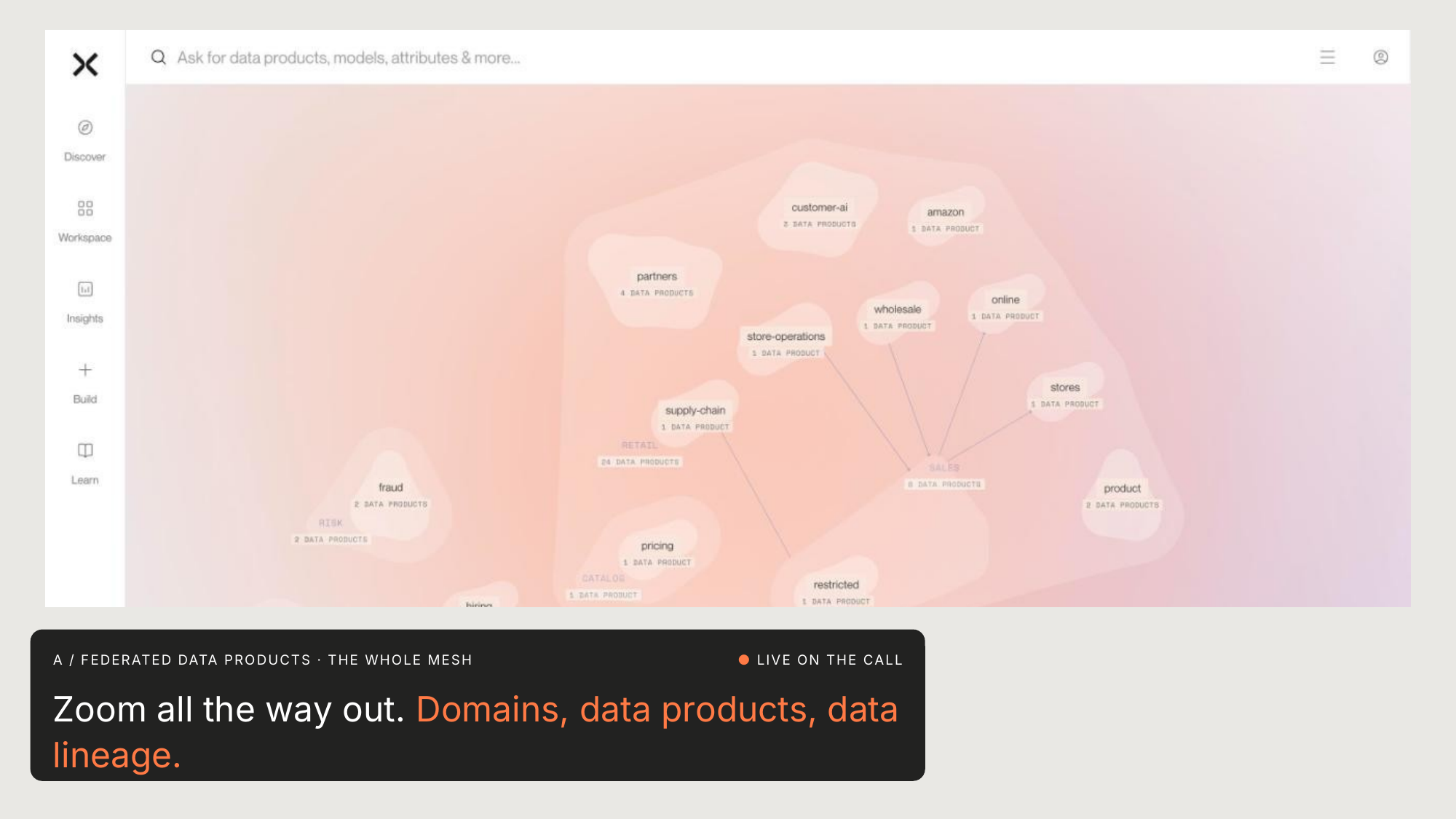
1. Start zoomed all the way out
We opened Nextdata’s Discover view zoomed all the way out. What you see is the whole mesh: every domain, owned by its own team, with lines showing lineage between them.
Nobody drew this map. Each data product declares its inputs, its owner and its domain, and the picture builds itself. That matters more than it sounds. In most enterprises, the map of what data exists is a separate project that goes stale the week it ships.
2. Every part of the question is owned by a data product
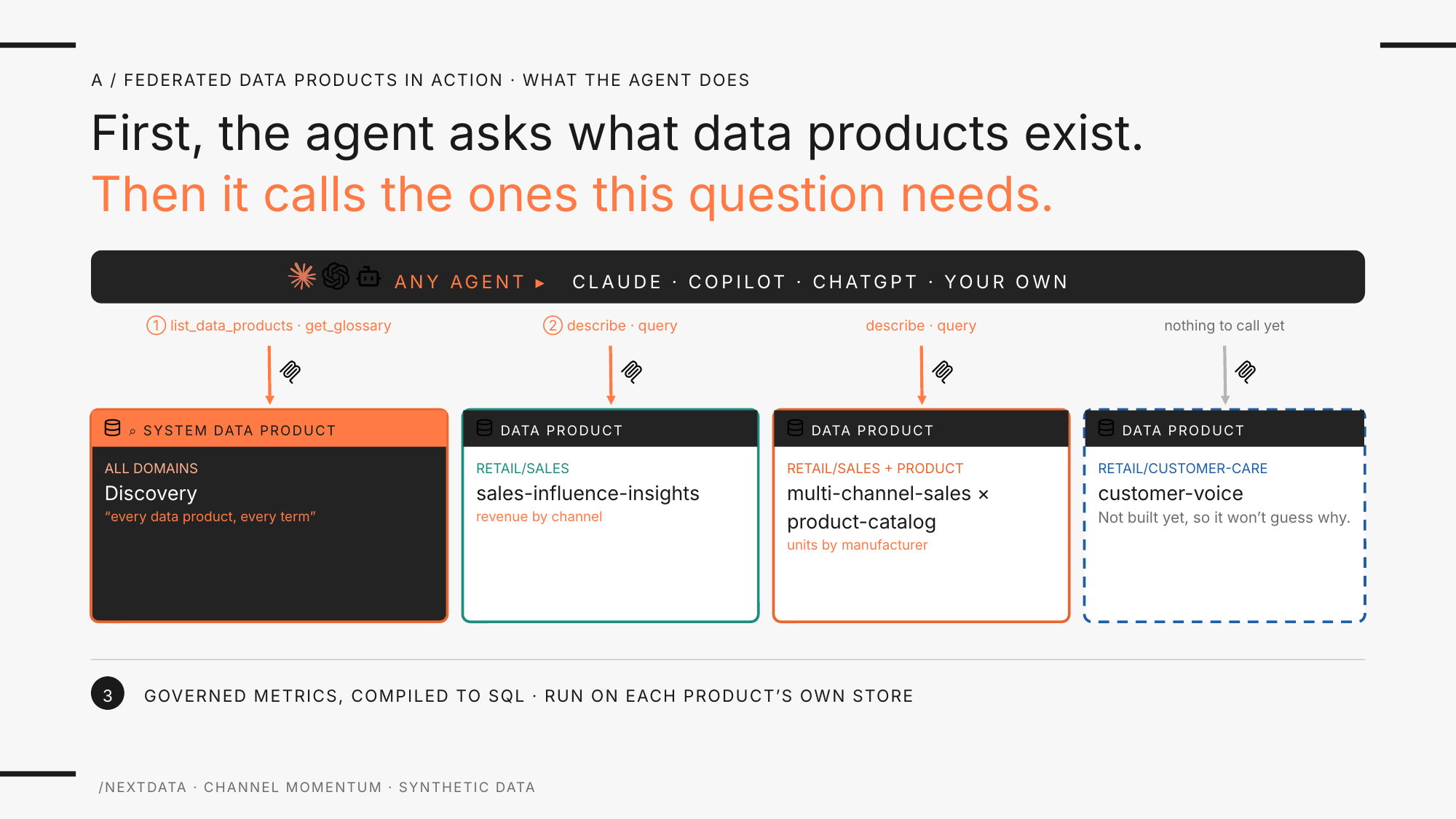
The question breaks down cleanly. Revenue and channel belong to sales-influence-insights. Units, momentum and region belong to multi-channel-sales. Manufacturer and product belong to product-catalog. Each is owned by a different team, and each runs on the engine that team chose: Databricks, Snowflake, or both.
The why, what customers say, had no product yet. Hold that thought.
3. The agent asks before it answers
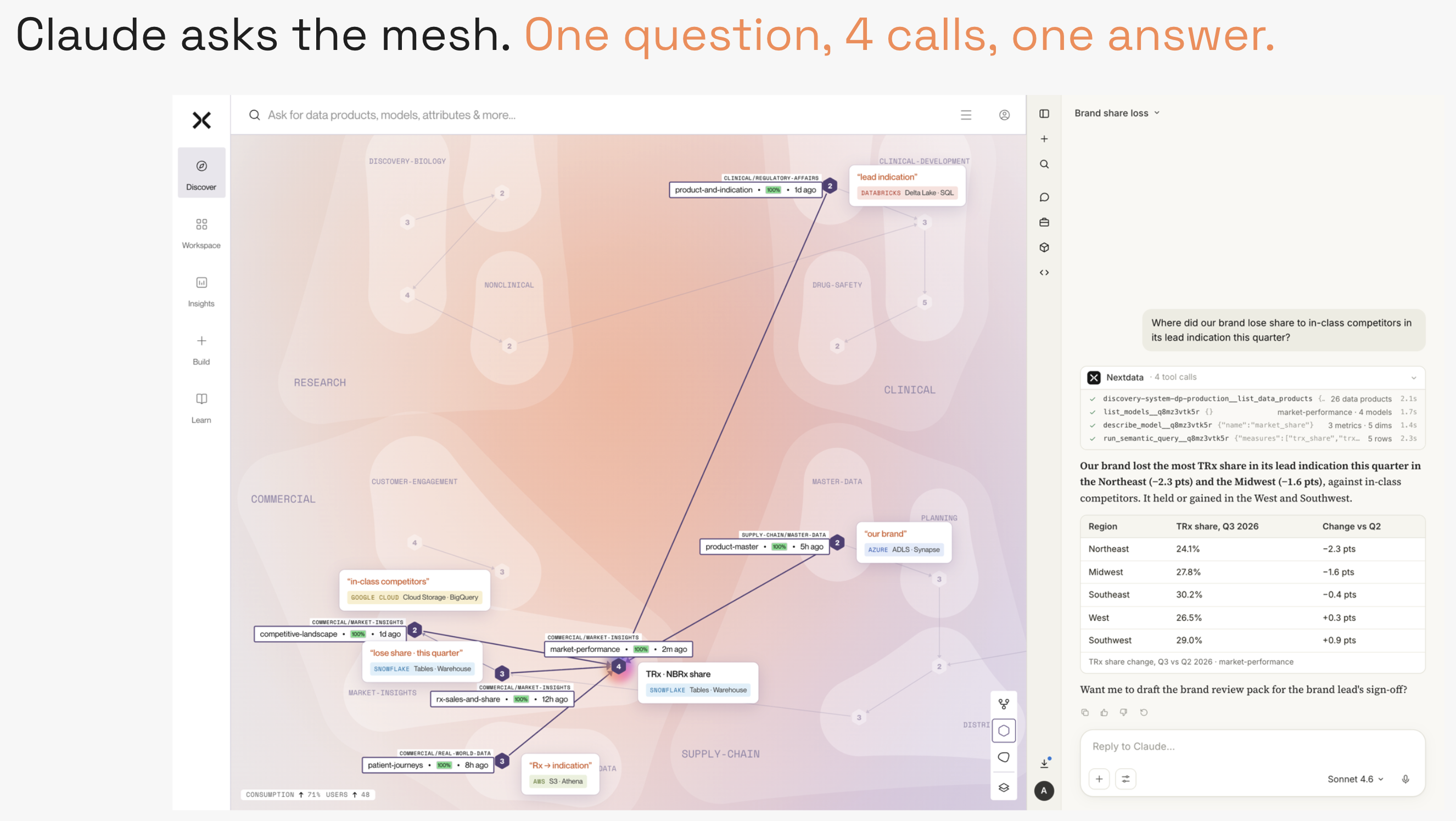
We asked Claude, connected to the mesh over MCP, which consumer channel brings in the least revenue. Nothing was copied to it.
Here is what any agent does on Nextdata, whether it’s Claude, Copilot, ChatGPT or your own:
- It discovers first. It asks the discovery product what data products exist and what the terms mean.
- It calls only what the question needs, over MCP.
- It never writes SQL against tables. It asks for a governed metric, such as revenue, by name. The platform compiles the query and runs it on each product’s own store.
The answer: online is the weakest channel. A follow-up, which manufacturers are losing momentum online?, came back with one name, Kelly, Lee and Norris. That answer joined two products owned by two different teams. Nobody built a pipeline for it.
Then we asked why. The agent told us where, APAC, and refused to guess why. The reason lives in what customers say, and no product published that yet. An agent that knows where the data stops is an agent you can trust.
4. What a data product actually is
We opened sales-influence-insights. A data product is not a table. It has an owner, a domain, a description in business language, and it’s findable by people and agents alike.
- Many sources in: store sales from ADLS, wholesale from Databricks, online sales, and news and social APIs. Systems like SAP or Salesforce come in the same way, as source products.
- Many outputs out: Databricks, Snowflake, a vector store and an MCP API, all from one product. Each team picks its engine. Because the outputs are ordinary tables, Power BI or any BI tool reads the same governed product the agent does.
- Structured and unstructured together: news articles sit next to sales tables in one product.
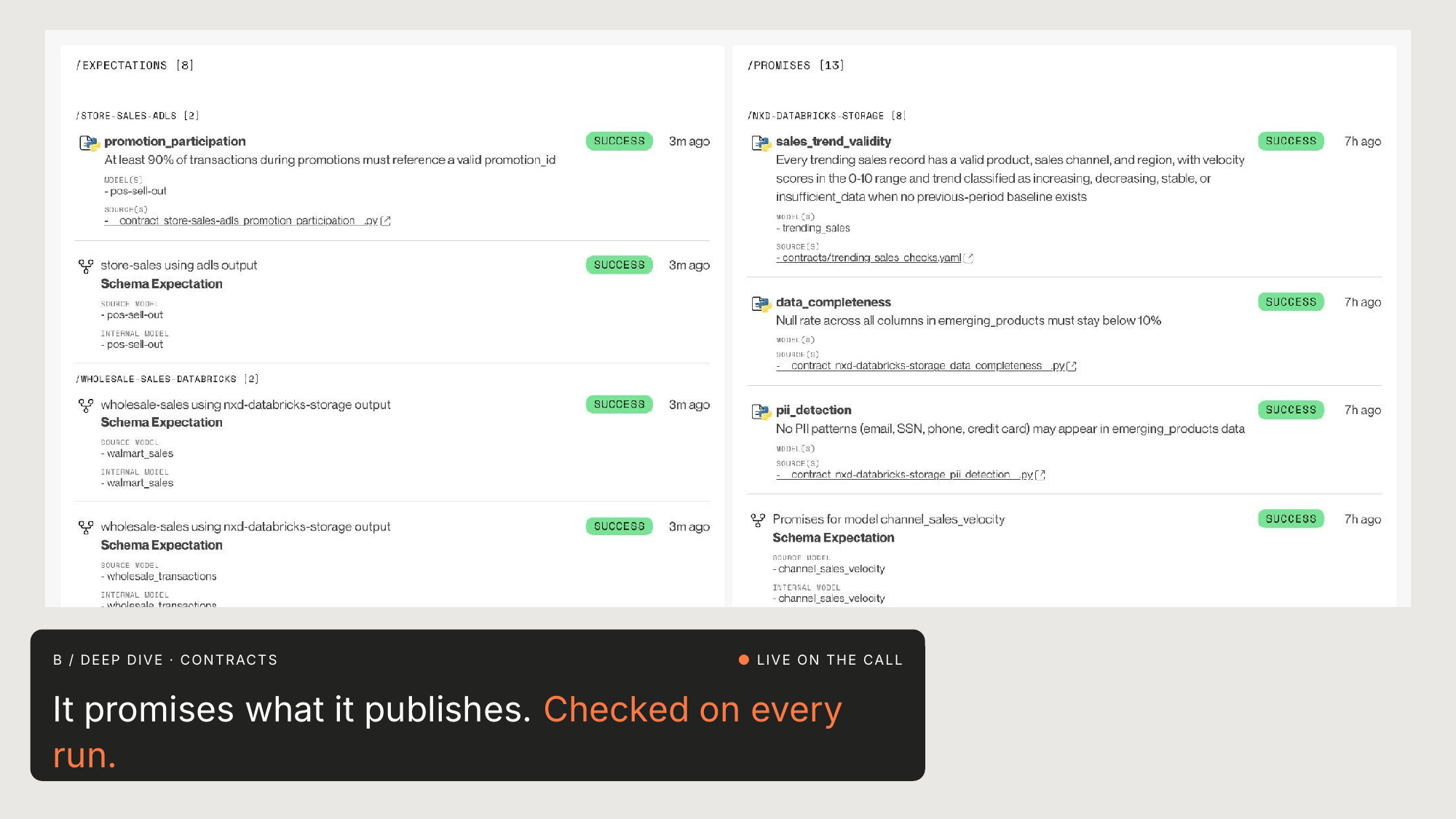
- Promises, checked on every run: the product checks what comes in and promises what goes out. This one makes 13 promises, and it tells you whether it’s keeping them.
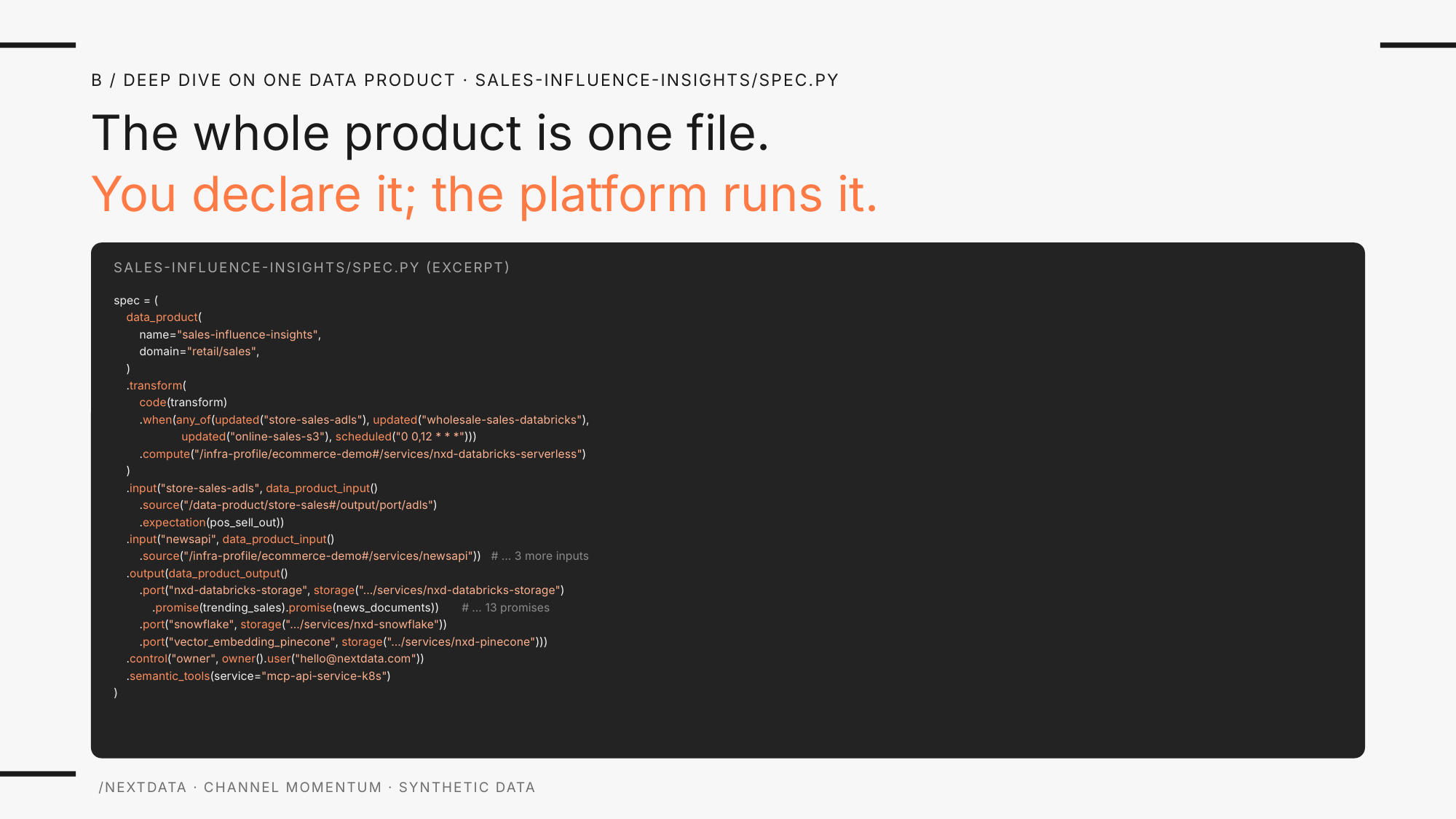
And here’s the part that surprises people: the whole product is one file. Inputs, transform, where it runs, outputs, promises and owner are all declared in a single spec. You declare it; the platform deploys it, runs it and checks it. No orchestration code. That’s the control plane.
5. Build the missing product
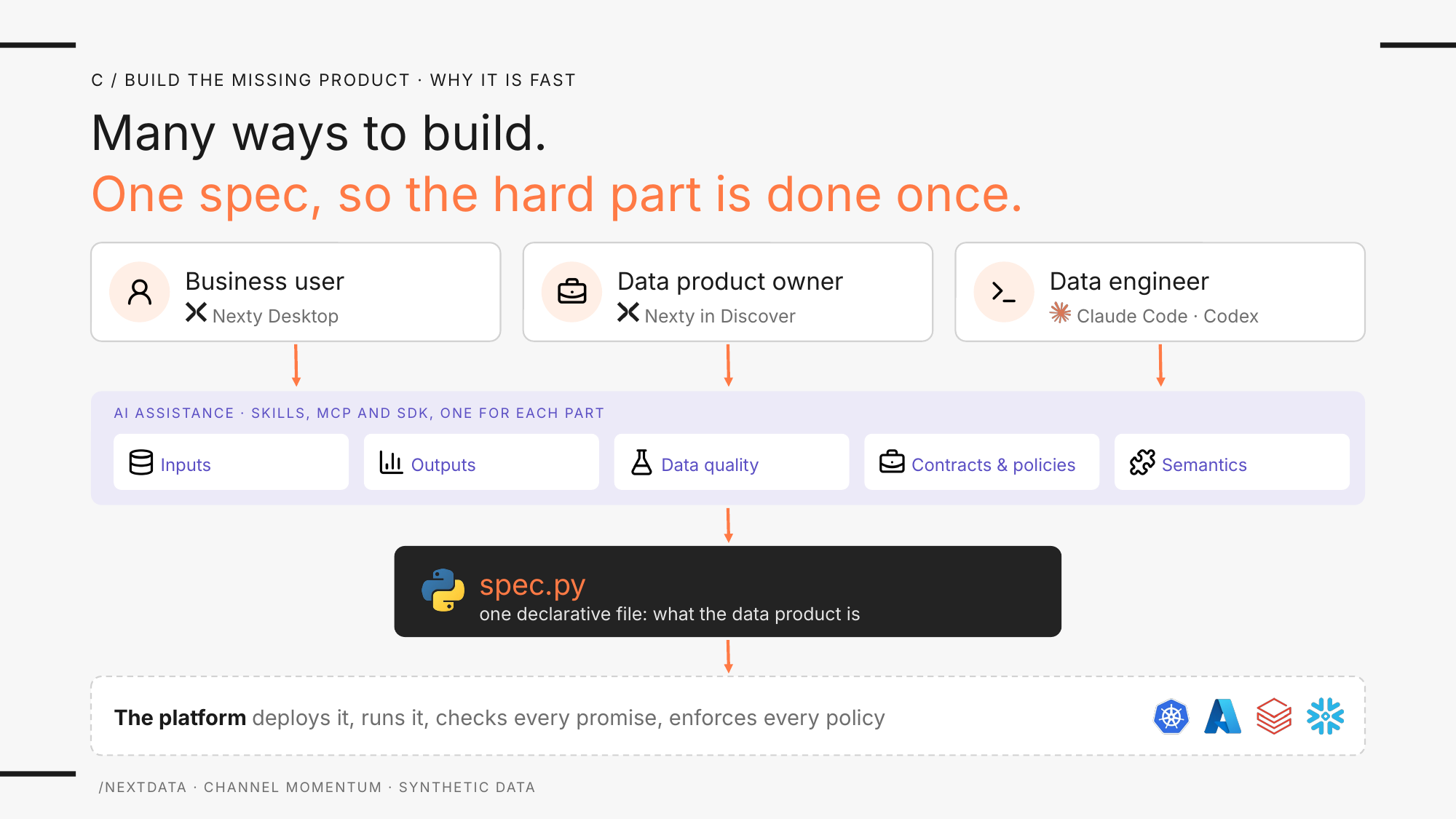
Why can we build a new product in minutes? Because Nextdata OS is a foundation that already did the hard part. The spec it runs is an abstraction layer: one declarative file that says what a data product is. Nextdata OS implements MCP endpoints and skills, and executes the spec, which includes everything else: inputs, outputs, data quality, contracts and policies, semantics.
So whoever builds, a business user in Nexty Desktop, a data product owner in Nexty in Discover, or an engineer in Claude Code or Codex, their AI assistant only has to fill in the spec. The platform does the rest.
Nobody starts from a blank page, either. Nexty can start from what the organization already has:
- Systems and data, such as SAP, Salesforce and the lakehouse
- Code and pipelines, such as dbt and PySpark models
- Reports and questions people already ask
- Documents and knowledge, such as PRDs, ontologies and briefs
Our skills read from source, find candidate products, infer models, metrics and joins, and turn a brief into a spec. Users run it domain by domain.
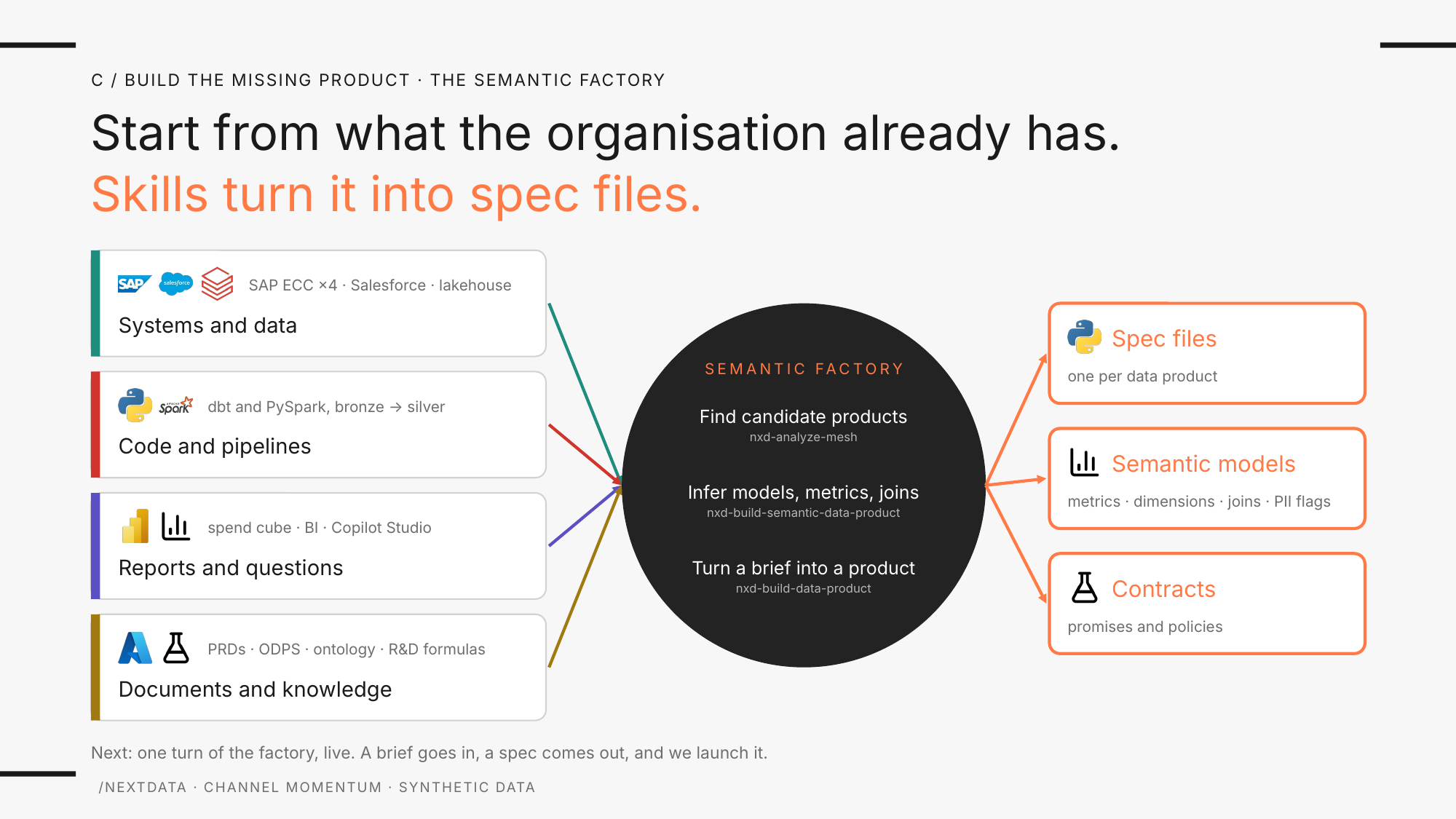
In the demo we ran one turn of it. In went a one-page brief from customer care: what they need, the questions it must answer, and one rule, no personal data. Out came customer-voice, a spec built with Claude Code and available to Nextdata OS skills, then reviewed by a human. Its transform uses an LLM to label each complaint, with the API key in a managed secret, not in the code.
One command, nxd launch, and it was running in about 20 seconds. On its first run it read 1,280 reviews, stripped names and emails, labeled every complaint and checked the result before anyone could read it. Promise passed: no personal data in 1,280 rows.
From one page of intent to a running, governed product in minutes. A project that usually takes months.
6. Same question, now answered
We asked the agent the same question again. Same agent, same question. The only difference was one new governed product.
Now it answered: the drop is in APAC, and APAC customers say the taste changed. One answer from three teams’ products. And it still said what it couldn’t know: nothing holds recipe changes. That’s how you reduce hallucination. The agent knows where the data stops.
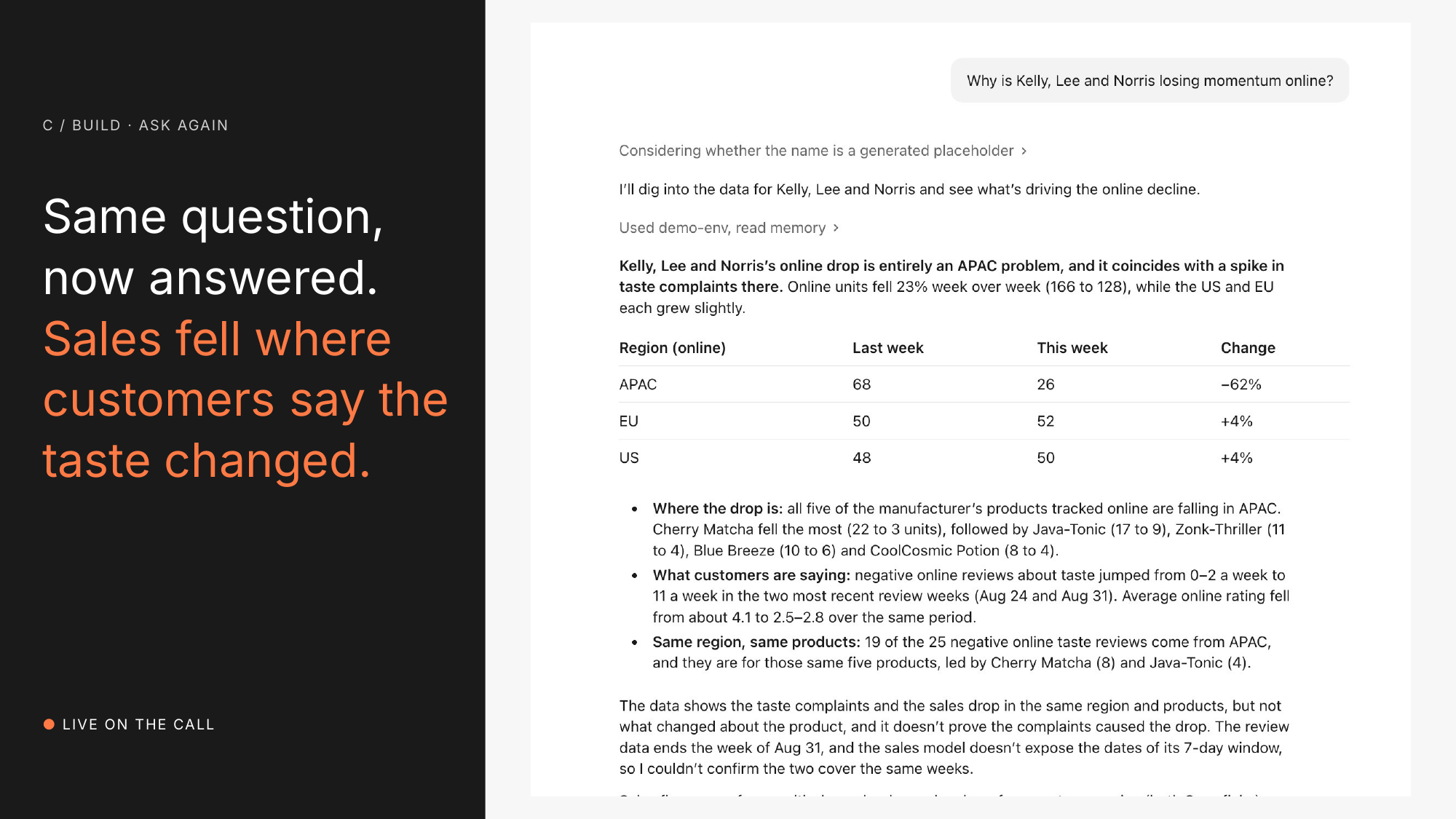
As products land, what the company knows grows with them. This is the semantic mesh at work: models, terms and joins across products, owned by the teams who know them best.
7. Governed across all of them
How does all of this stay safe when agents can reach it? We asked Claude about the mesh itself: which products hold personal data, and which of those can an LLM read? Of the products on the mesh, 8 hold personal data, 13 talk to an LLM, 3 do both, and in 2 an agent can actually reach the personal data.
So we wrote one rule as code: no personal data reaches an LLM. We dry-ran it on every product before switching anything on. Then we turned it on. Two products warned, because agents could filter on a personal field, and two passed. Their owners got the warning; nothing else broke. You choose the consequence: warn, stop, or shut it down.
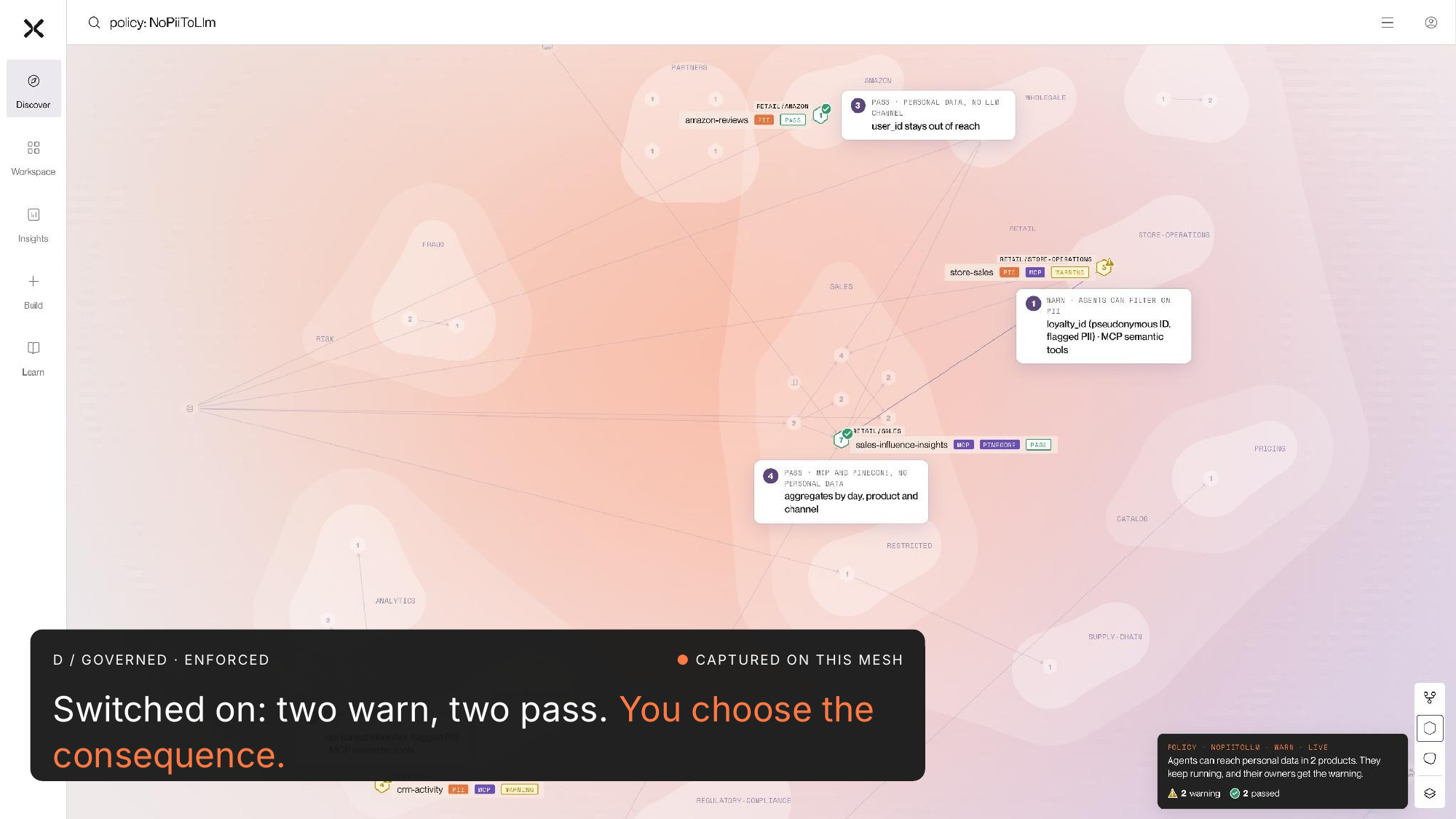
That also explains why customer-voice was governed from its very first run. We never attached a policy to it. A rule sits on the customer-care domain, and anything launched there inherits it. If it ever publishes a name or an email, it stops.
Governance isn’t a review after delivery. It’s code, on domains and products, checked on every run.
The questions we hear most, answered
The questions we get tend to cluster around four themes: federation, semantics, delivery speed and governance. Here are the ones that came up most, with the short version of our answers.
How is an autonomous data product different from a table, pipeline or catalog entry?
A table is storage. A pipeline is plumbing. A catalog entry is a description of something that lives somewhere else. An autonomous data product is all of it, packaged as one unit: the data, its transformation, its meaning, its policies and its quality promises, with an owner and a domain.
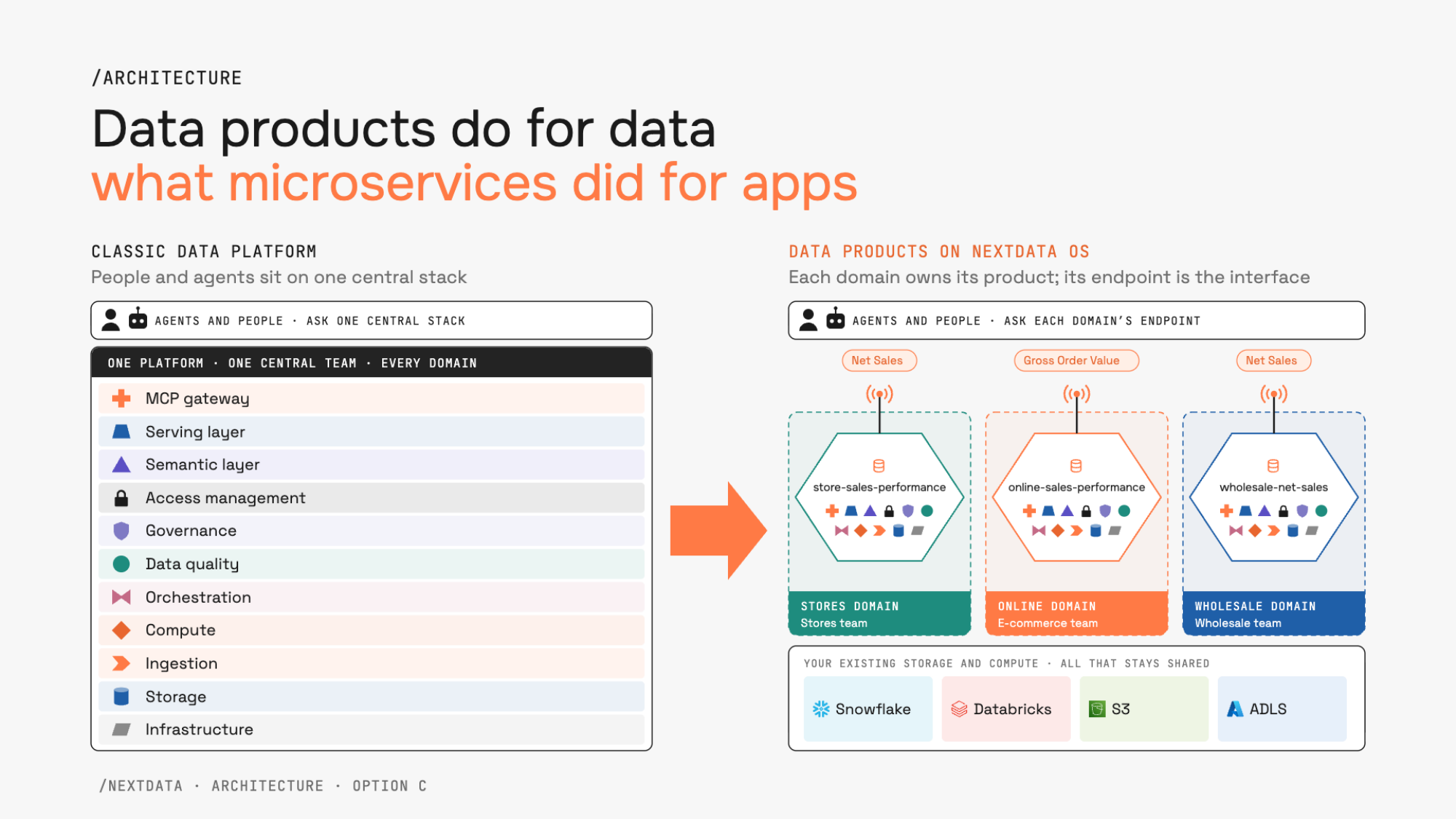
It’s declared in a single spec, and the platform deploys it, runs it and checks every promise on every run. It serves the same governed data to Databricks, Snowflake, a vector store and an MCP endpoint. As we put it at the end of the session: data products do for data what microservices did for apps.
Do we have to replace our existing stack?
No. Storage and compute stay where they are: Snowflake, Databricks, S3, ADLS. Data products read from your existing sources and publish back to the engines your teams already use. Systems like SAP and Salesforce come in as source products. Your BI tools keep working, because a product’s outputs are ordinary tables.
What changes is the shape of the middle. Instead of one central stack, with one central team serving every domain, each domain owns its products, and each product carries its own serving, semantics, access, governance and quality. An ontology or knowledge graph can sit next to the mesh and link to its terms.
How do governance, access control and quality hold up when data is decentralized?
Better than in a central model, because they travel with the product instead of living in a review queue. In the demo:
- Quality is a set of promises the product makes about its outputs, checked on every run.
- Policies are code. You write a rule once, dry-run it across every product, then switch it on and choose the consequence: warn, stop or shut down.
- Domain rules are inherited. A rule on a domain applies to every product launched in it, from its very first run.
Decentralizing ownership doesn’t decentralize the rules. It makes the rules enforceable at scale.
How do agents find the right data across domains?
They ask. Every agent starts with a discovery product that knows every data product and every term on the mesh. From there it calls only the products a question needs, asks for governed metrics by name, and lets the platform compile and run the query on each product’s own store.
Because each product carries its own meaning, the agent also knows what it can’t answer. In the demo, it refused to guess why sales fell until the product that held the answer existed.
What does it take to start, and how fast is value?
You don’t start from a blank page. The semantic factory starts from what you already have: systems, pipelines, reports and documents. It turns that context into specs that a human reviews. In the demo, one page of intent became a running, governed product in minutes.
With customers, we start with one high-value, AI-native use case and a handful of products in a single domain. Then we incubate, operationalize and federate, domain by domain, with our forward-deployed engineers working alongside your teams.
What’s next
The demo made one point clear. AI-native isn’t about a bigger central platform. It’s about many small, owned, governed products that agents can discover and trust, and that grow what your company knows every time a new one lands.
We have more to show. Save the date for December 9, when we’ll reveal what’s coming next for Nextdata. Watch this space.
More resources
- Watch the full recording of AI-Native: Ask Us Anything
- Read The semantic mesh: activating enterprise context beyond MCP connectivity
- Ready to see it on your own data? Request a demo and talk to our team.