AI-ready data products
AI-Native Pharma: Customer Case Study - Putting a trusted context layer to work at argenx
[This is a recap of the latest session in our AI-Native webinar series. Earlier sessions covered frameworks, concepts and product features for building an AI-native company. This one featured a customer who is doing it.]
Thank you to everyone who joined. In our first AI-Native sessions, we talked about what it takes to become AI-native. This time we heard from someone in the middle of the work.
Zhamak Dehghani, Nextdata's founder and CEO, sat down with Omar, Global Head of Data and AI at argenx, one of the fastest-growing companies in immunology. Omar brings more than two decades in life sciences and consumer goods: about ten years at Novartis, from CIO roles to leading commercial analytics; head of business intelligence and analytics at Roche Diagnostics, where he and Zhamak implemented one of the early data mesh programs; global head of data and analytics at Givaudan; and a year and a half at Novo Nordisk. At argenx, he is building the next generation of data and AI operating system: a trusted layer ready for humans and AI, usable by any LLM and any agent.
The conversation ran from mandate to architecture to operating model to what comes next. Here are the highlights.
The mandate starts with patients
Most data leaders spend their first year fighting for a business mandate. Omar arrived with one already in place.
Every "argonaut," as argenx employees call themselves, works toward the same Vision 2030 targets: reach 50,000+ patients, launch 10 new indications, and bring five new molecules into late-stage clinical trials. Omar's team frames its work around a single question that follows from those goals: how can AI make every argonaut 10x more impactful?
That framing shaped the first decision Omar made after joining in January 2026. argenx had solid groundwork, built in four fast years since going commercial. Like most pharma companies, it was born in the cloud and ran multiple hyperscalers with multiple tools at every layer. The team could have chased technology for its own sake. They chose to anchor everything to business outcomes.
"It's not about implementing AI or agents or some tool for the sake of implementing it," Omar said. "It's about the impact that we want to create, the outcome that we need to deliver."
Zhamak called out why this matters. Large platform programs tend to fall into a familiar trap: spend a few years building, expect the business to show up, watch it fail to show up, start the cycle again. At argenx, the work began on day zero with use cases, KPIs and company targets.
Use cases span the whole value chain
argenx's roadmap runs end to end, reflecting cultural pillars of co-creation, innovation and partnership. It covers:
- Research and development, including clinical trials, regulatory and project management
- Manufacturing readiness, supply chain, distribution and quality
- Commercialization, up to the point the product reaches patients
- G&A functions such as finance, legal, communications and digital technology itself
The data behind those use cases is just as varied: lab equipment, clinical operations, real-world evidence, Salesforce and Veeva, and Oracle ERP. Omar's team has learned from the data lake era. They start with the outcome, even a small one, and pull in the data it needs.
Those use cases span the full analytics spectrum, from agentic AI to traditional BI. "People would say dashboards are dead, but they're not really dead," Omar noted. The requirement is to serve every mode of consumption at once, with the same trusted data underneath.
Optionality at the top, a thin layer in the middle
argenx arrived at the hourglass model before it had a name. Sina and Zhamak described it in our session two weeks earlier. Omar recognized his own architecture in it.
The bottom of the hourglass is wide. It holds many internal and external sources, structured and unstructured, plus the ontologies and semantics that data leaders have tried to put to work for years. LLMs and agents can finally combine all of it.
The top is wide too, and getting wider. BI tools used to be the main way to consume data. Then scientists arrived with notebooks and Python. Now there are agents, harnesses and many models. Each new consumer used to mean another copy of the data, another silo, and another place where meaning got lost.
Omar's strategic choice at the top is optionality. "There is no need, or there is no way at the moment, to single out one model provider," he said. "Many models are great for different purposes." The model is a means to an end. The end remains impact for argonauts and patients.
Zhamak sharpened the point. Model behavior can shift dramatically from one release to the next, and Nextdata sees its own engineering team's behavior change with each release. An organization that bets on a single harness or model will be whipsawed. Optionality has to cover the harness and agent experience as well as the model.
The middle is where Omar is uncompromising. That narrow waist holds data products together with their semantics, access controls and code, defined properly. "You know I'm a stickler of proper data product definition," he told Zhamak. The alternative is a table in Snowflake, another in Databricks, a catalog somewhere else, and an ontology in an Excel file nobody can connect to. Bringing those together in one layer is what lets AI unlock value from data.
The stack itself has changed since the Roche data mesh days. Then, the team picked technologies and integrated them layer by layer, and the stack was tall. Now it has shrunk in height and widened at both ends. Omar was candid that the middle layer still takes real effort. What keeps argenx moving in the right direction is the conscious architectural choice behind it.
From one analyst to orchestrated agents
Zhamak asked Omar to walk through how an agent gets to a reliable answer at argenx. He gave two examples.
Example 1: the analyst with a harness. Analysts are argenx's power users inside the domains. They used to work in BI tools or notebooks. Now they field questions from management and generate insights with AI harnesses, connecting to data products as well as strategy documents and files that aren't yet part of the data product setup. As the company scales, the analyst team doesn't have to scale with it.
Here is how it works:
- Pick a harness. argenx works with several, including Perplexity and Claude.
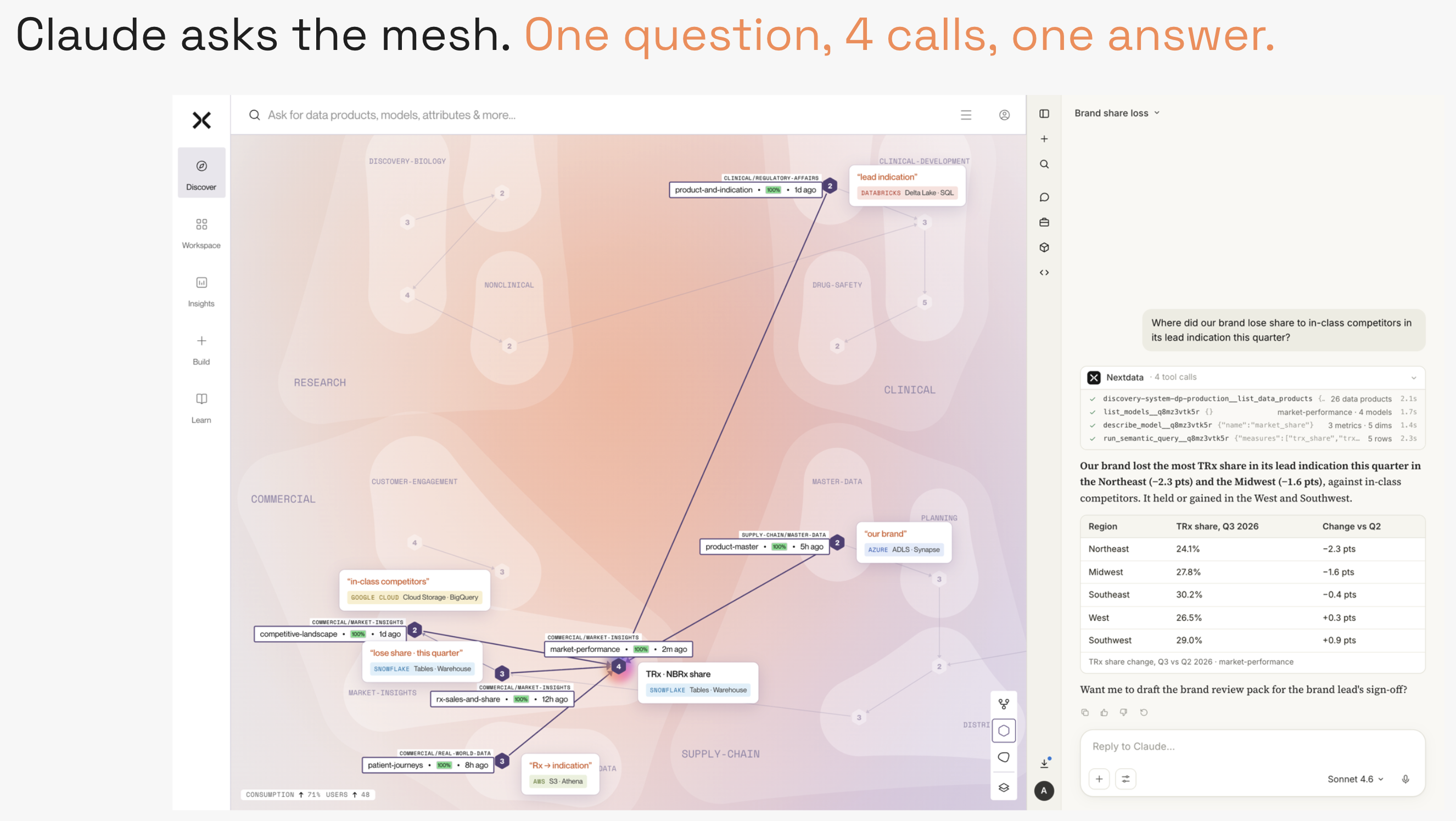
- Connect through MCP. Nextdata, part of argenx's enterprise data platform, exposes MCP endpoints that let any harness connect to the platform securely.
- Let the data product carry the rules. Semantics, context and security live in the data product, so any harness, or a BI application, reaches the same data products under the same controls.
- Build and share. Analysts generate interactive and live dashboards based on their own access, then share them as presentations, insights or apps, with full observability and auditability.
Add actions such as sending emails, refreshing dashboards or recommending a next best action, and the assistant becomes an agent. Omar admitted he has run a five-year next-best-action program in the past. That kind of project now collapses into a conversation. Zhamak added that Omar has vibe-coded his own dashboards for tracking his team's productivity and platform adoption, served from the same secure layer.
Example 2: reimagined processes. The bigger shift is rethinking how humans and AI work together. That means a series of orchestrated agents, some running inside SaaS applications and some built custom. SaaS tools that used to be data sources are becoming smarter applications that need shared context too. Any process is a candidate: hiring, invoicing, procurement. Omar's team is practicing what it preaches by running its own data and AI use case assessment process with agents. Whatever the process, every agent draws from the same trusted foundation of AI-ready autonomous data products.
Controls on by default
Pharma is one of the most regulated industries there is. GxP processes must be tightly controlled and fully documented with audit trails. On top of that, argenx runs a responsible AI program and must respect data privacy, data residency, GDPR and the EU AI Act.
Omar sees good timing here. Some industry governance bodies are updating how they view these processes. argenx is using the moment to automate and qualify its platforms as far as possible, so that data and AI product teams do minimal validation work. "If something can be tagged private or PII or PHI relevant, controls should be implemented 100% of the time," he said.
That only works with a narrow, governed layer in the middle. Data scattered across systems with no data product boundary and no domain ownership can't be controlled consistently. Within each data product's boundary, argenx automates controls by classification, availability and integrity requirements, using role-based or attribute-based access control. The controls hold wherever and however the data is consumed.
The domain teams, cross-functional groups of IT and business, decide which controls are needed. They know the data. A centralized, disconnected team can't make those calls. The platform's job is to give domain teams the automation and tools to act on their decisions, and argenx's platform success team onboards each domain and feeds what it learns back into a bootcamp offering.
Zhamak drew out the larger point. The narrow waist of the hourglass is standardization: shared semantic definitions and autonomous data products that enforce access at every point of interaction. That standardization is exactly what lets ownership of data products, agentic solutions and semantics move out to the domains. Standardization and federation are two sides of the same coin.
Domains are the foundation
Omar was frank that the hardest conversations happen before any development starts. Why do we need domains? To many people it sounds like a PowerPoint and a governance exercise. "It is the foundation for everything that we do," he said. As he wrote in a blog post a few years ago, data products don't live in the wild. They live inside a domain boundary, with an owner.
argenx draws its domains around where data is generated and where its owners sit, which brings the company's co-creation culture to life. Each domain boundary also names the systems and processes maintained within it. Where value streams cross domains, the team can see which cross-domain experiences, AI products and agent orchestrations will be needed. Data ownership and agent ownership are now linked, and decisions no longer get made in silos.
The rollout is tailored. Some teams were already mature from earlier analytics work, and others are just starting. "It is not a cookie-cutter approach," Omar said. "You go and meet the business users where they are and bring them with us."
Part of the job is holding the line on definitions. "You can call anything a data product and make people happy," Omar said, and much of the industry has. On a maturity curve from level zero to level five, many teams get stuck around level one. Zhamak noted that this is why Nextdata raised the bar to autonomous data products, with a runtime that serves MCP endpoints and semantics directly.
Omar credited his team, whom he called the best data and AI team he has ever worked with, for making it happen.
AI amplifies everything, garbage included
Zhamak put Omar on the spot. She has long argued that centralizing data and control won't scale and that federation has to happen. AI has brought that moment sooner than she expected. Now anyone with a Claude or Perplexity harness feels empowered to copy data somewhere, put an MCP endpoint on a table and get moving. How do you balance that ambition with control, especially in a regulated industry?
"AI is a true amplifier," Omar answered. "The goodness becomes amplified, and the garbage also becomes amplified very soon."
He encouraged everyone to try the harnesses. With the right skills, they produce impressive dashboards and visual stories. The question is whether the numbers behind them are real sales figures or something the model hallucinated. A model pointed at a table may be fine for personal expenses. Enterprise data shared by every consumer needs reusable, AI-ready data, with definitions supplied by the domain where the data is produced.
Omar described the old pattern as "disconnection after disconnection." Data engineers stopped at ingestion and transformation. Governance teams kept stale, disconnected catalogs. Ontologists and taxonomists worked in yet another tool. Inside an autonomous data product, the meaning lives with the data, and shared semantics connect data products to one another. argenx uses the FAIR principles, making data findable, accessible, interoperable and reusable, and adds AI-ready to the list. Definitions that sat in stale systems for years are finally active.
Zhamak closed the loop on Nextdata's design goal. There is one reality, expressed as business concepts and definitions, and it should share a single lifecycle with the mechanism that produces the data. Agents depend on that truth of meaning, metrics and relationships to compose the right question and send it to the right endpoint. An MCP endpoint with semantic extensions is what delivers it.
Brace for change every four weeks
argenx and Nextdata started this journey in May. Omar sees Vision 2030 as the first stop. The plan is to keep working across every domain, keep learning, and keep the patient goals in view.
His advice to his own team applies to everyone listening. Release cycles used to be quarterly or annual. Now everything changes every four weeks, and technologies cannibalize each other month over month. "Brace yourself," he tells them. A learning and growth mindset lets the team absorb what it needs while staying anchored to 50,000+ patients, 10 new indications and five new molecules.
Zhamak's parting word to life sciences listeners: keep an eye on argenx.
More resources
- AI-Native Pharma: From Context to Action, our recap of the previous session with Sina and Zhamak on the hourglass model
- Book a meeting with the Nextdata team to see autonomous data products in action